

Gemstones
The Unsung Hero of Alternative Investments

Our Family Office, Henmil Group Family Office, has become known to date as the only family office in the world specialized in regenerative investing. What does this mean? It means our research has shown us that the global aggregate failure rate of conventional investing practices to deliver expected financial returns is 70% and despite a $USD1.16 trillion impact investing market, we have seen zero impacts in our systemic social and climate data. What a lot of wasted capital!
So we have incorporated regenerative methodologies into our core strategy and investment practices, as our research also shows that when assets across different asset classes, including, but not limited to real estate, infrastructure, direct investments and commodities work with this methodology they are incredibly performant, with effective returns across 60% of those assets studied (double that of conventional performance) and evidence of systemic impacts across an integrated view of ecology, economy, society and culture and heritage. We also found significant evidence of resilience across macro-shocks and volatility, were at a time that we are seeing the most protracted period of market volatility since the 1960’s according to the UN, this resilience is critical to ensuring the reliability of the future value of our assets.
Whilst we are clear we are applying one of the most resilience generating methodologies to our portfolio, it is still good investment practice to hedge inflationary risk and to this I am singing the praises of the unsung heroes of alternative investments – gemstones.
Let’s take a quick look at the history of gemstones.
The gemstone is the world’s oldest commodity, dating back as long as 5,500 years, and holds more historical and cultural importance than probably any other investment options. Royal families have collected gemstones to preserve wealth over time and for future generations. Whilst I am also a believer in gold as a hedging investment, gemstones have the highest concentration of value, even higher than gold, and can return great yields.
Notable modern day investors included J P Morgan, whose first gem collection was put together with the help of the the famous gemologist from Tiffany & Co., George F. Kunz. This collection of gems and precious stones from North America (over 1,000 pieces) was exhibited at the 1889 World's Fair in Paris. In fact, following the discovery of a new locality for rose beryl in Madagascar in 1910, George Kunz proposed the name “morganite” at a meeting of the New York Academy of Sciences on 5 December 1910 to honor his friend and customer J.P. Morgan.
The growth in value over time in gemstones is a clear trend with many gems becoming rarer with limited supply, so much so that many gemologists no longer differentiate between what once was formerly known as precious and semi-precious stones. They are now all considered gemstones.
For example, a 10-carat Paraiba tourmaline from Brazil that was worth $50,000 in 2010 had risen to $200,000 in 2019. All untreated coloured stones have risen steadily in value over the past ten years. Investing in gemstones serves as a diversification, like buying a painting, and it’s a little-known subject. Genuine investment stones only represent 2 to 3% of the market.
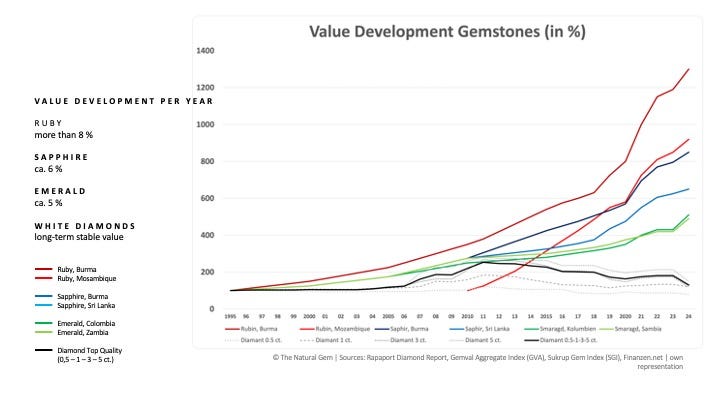
There is much to be done at the level of the mine to make gemstone investment regenerative. Still in some countries there are many human rights abuses, poor extractive methods that are devastating for ecological and social systems but given our frequent appearances as a family office at Commodity Trading events, we seek to transform destructive practices inherent in many commodities sectors. That is also why, investment at the level of the mine is also becomes increasingly interesting for family offices and multi-family offices who are committed to or learning about regenerative investing.
In the meantime, as a Family we have aligned ourselves with The Natural Gem in Vienna. Mr. Thomas Schroeck, Director of The Natural Gem has over 30 years’ experience with gems, and I have not yet met a man as knowledgeable as he. All his gems are sold along with an internationally recognized, independent certificate from a gemmological institute and are of the highest investable quality. He sources directly from the mine so can also offer a sustainability rating on your investment.
I would recommend holding 10-20% of the value of your portfolio in gemstones as both a value investment and a hedge strategy.
To learn more about the unsung hero of investments – gemstones, contact me at peta.milan@henmilgroup.com or Thomas Schroeck at office@thenaturalgem.com